Showing posts with label Vajrayana. Show all posts

Sunday, October 26, 2008

Pilgrimage 2008

Gull above Lakeport, California

Fall Foliage in Cobb, CA

I just got back from a pilgrimage to several places of significance to the Nyingma Buddhist lineage in California and Oregon, along with some other fun along the way.

I left Oakland on Oct. 26th, and wound my way up through Calistoga and Cobb, where I landed at Douglas' house in Lakeport on Clear Lake. Douglas and I drank wine and discussed the integration of the view of Dzogchen with daily life, late into the night.

Monday, September 29, 2008

A Truly Civilized Funeral


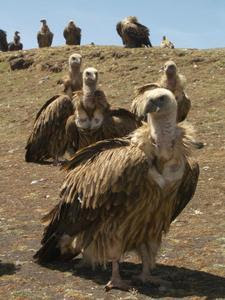
Tibetan vultures waiting to eat

Today I picked Lama Pema Dorje and Kunsang up at SFO after he had spent the weekend teaching in Olympia, Washington. We all did our own thing when we got back to the house. At dinner, I went in to the kitchen to show them a photo of Dzongsar Khyentse Rinpoche in a funny green fright wig that symbolizes his commitment to the environment, and talked with them about the pollution and global warming.

Then, they brought up an art project I am anticipating that will involve needing a few vulture feathers. Vulture feathers are illegal to sell in this country, so I have been planning to visit my high haunts in the Oakland hills to see if I can find any. But Rinpoche and Kunsang have been looking for them for me too, which I find very sweet.

The subject of vultures now having been broached, I asked Rinpoche if they did Sky Burials where he grew up. He was raised in the 1940’s in the ethnically Tibetan borderlands of Nepal and Tibet, called Dolpo. He said yes, he had seen many sky burials as a boy, because his father--a well-respected lama of the region--performed them. Actually, the people in the region generally buried people, but his father encouraged sky burial practice.

The night before the sky burial was to take place, the lama would do a chod practice--playing his chod drum, blowing his kangling, and singing the sadhana--at the house where the corpse was. This was a standard Throma Chod practice, with just a few words changed. Kunsang says, this is like calling up the vultures, believed to embody the dakini principle, and inviting them to lunch the next day. Rinpoche describes the Tibetan vultures as much larger than the ones here, or those in Nepal proper. They are about the size of a sheep, he said, as he described the beauty of each part of their body with great appreciation; he gestured with his hands to illustrate the white feathers here, the black feathers here.  Particularly wonderful were the fluffy white feathers under the wings that were like fur.

So, the next day, the assistant lama would carry the body to the charnel ground on his back, then put it down and cut it up. There is a special name for this assistant, one of the main lama’s students, and the role seems to have a pretty clear job description. Then, his father would start performing the chod practice.  There is a special cemetery liturgy in this collection of practices.  The vultures would come and eat the body completely within 20 minutes. It took a certain number of vultures to eat a large person's body, and a smaller number to eat a child’s body.

As it happens, one time a 16 year old boy died, and another lama in a different area performed the chod for him in the winter. When the body was offered, no vultures came. The lama buried the body under stones. The family was very upset, and there was a belief among the locals that the dakinis had not come for the boy because he must of been very un-virtuous. So, when Rinpoche’s father came through the area in the spring he was asked to remedy the situation. The night before he did the practice, called “shaking the nest,” to let the vultures know to come the following day. He was kind of joking around saying something like, “actually we need 11 vultures for this size man.”

Then they went out and dismantled the impromptu cairn on the body with the help of the local lama, who was a student of Rinpoche’s father. The corpse now looked like a partially frozen pile of blackened meat, not really recognizable as human. They spread it out on a area the size of a blanket. As soon as his father started to perform the chod ceremony the vultures arrived in group numbering exactly 11. Rinpoche said some of the vultures landed the normal way, on their open feet, and others came it very fast at an angle and fell over when they landed. The way he described it, it appeared as though they had been hurled there, or as though a powerful magnet had drawn them there.

Saturday, March 22, 2008

Blessings


I remember hearing from classmates in high school that the first couple of times smoking marijuana one did not get high, then suddenly the third time or so, the drug would take effect. It seems that way with Vajrayana empowerments for me. The blessings of these Dudjom Lingpa wangs get more and more powerful with each passing day, seemingly a cumulative effect. I never understood why people wanted to receive these big cycles of empowerments, until I revieve the Dudjom (Jigdrel Yeshe Dorje) Wangs last year, and now this group.

I won't describe the sensation, for fear of disapating it, but it is palpable.

Today, after the wangs, I went out to lunch with a friend, then up to the Oakland Hills to walk as the sun went down. When I got up to the top of the MacDonald trail hill I found several wildflowers in full bloom, including groupings of the pink flowers above, with the fern-like foliage. They looked a bit like me--I had actually worn pink lip gloss today for the first time in my life. So, pink was the theme, I guess. Spring, flowering, fresh, clean, pristine.

On the way down the hill, this beautiful golden light.

Saturday, March 8, 2008

Oakland Dharma Bum Routine

Friday walk with Ellen in the Oakland Hills
Tonight at the Lake (and some iphoto fiddling)


I've developed a daily rhythm of breakfast ngondro and housekeeping until noon, then lunch and whatever project I have, then my time on the Shitro mantra garland from three to four. Next I walk, hike or climb for an hour(with or without company), then snack. Sometimes socialize, sometimes projects in the evening, then a tiny bit of practice again, then sleep. That's quite a life! Soon I will start getting up earlier so I am a bit more productive.

So, you can see why I haven't been posting. Not much excitement until the Dudjom Lingpa Empowerments March 16 - 27 at Orgyen Dorje Den. No, it's not on their website, but you can sign up for their email list there, and they send out frequent updates. Scott from ODD allowed me to develop some materials for him about Dudjom Lingpa, the great terton of the 19th century--so that he could condense it for a paragraph description on their forthcoming publicity.

Wednesday, March 5, 2008

Physical Support for the Dharma

Oakland Stairmaster

The sad fact that meditation practice has to be balanced with exercise. Prostrations are the general exercise prescription of our lineage, but a lot of middle aged sedentary people who start doing prostrations can lack the core muscle strength to protect the spine from the impact of prostrations (especially done on a prostration board) and can injure their backs that way. Then we stop doing prostrations and do nothing but sit sit sit. The abdominal muscles that support the spine become deconditioned, and one develops back, leg, and even abdominal pain. Pretty soon we have to lie down to practice.

So, in my own case I have started to reverse the process. Starting with one hour of walking a day for general conditioning, along with specific core muscle strengthening exercises, and stretches. I can't tell you how much better I feel. I can sit on a cushion straight up for two hours, what a relief.

Today I progressed to stairs, using the above stairs (that go way beyond what you can see in the above photo). Up and down and up and down.

Sunday, March 2, 2008


Pema Osel Ling today

Today was absolutely gorgeous. It was Dakini day, our bi weekly day of connection with the awakened activity--the sacred feminine. Everything coalesced around Throma, the most wrathful dakini. I decided to go to Throma tsok at Pema Osel Ling a few days ago. Then, Stacey at Dharma Treasures store at POL called to say that a shipment of statues ordered long ago had arrived, and would I like to buy a statue of Throma? I jumped at the chance, and arranged to pick it up today. Then I set up a massage appointment with Marcie, who lives near Pema Osel Ling for the same day. As I started t write this, I remembered that Marcie is a celebrated Throma practitioner. As I picked up the statue, someone in the bookstore commented to a friend that I look like the Throma statue I just bought. I said, "yes, we do look alike," but really this statue is much more sexy than I am.

Sunday, February 24, 2008

Berkeley Fish Release

We crammed in Alana's car, trying to keep warm while waiting for the animals to arrive.  Ellen and Stacey made merry.
Chimey loves handling crabs, and is fearless.
Marty gets ready for the liberation.
Over it goes!

After Anne's event a dozen of us did a life release tonight at the Berkeley pier.  We bought many clams and crabs, then gathered, said a prayer and a bunch of Om Mani Peme Hungs and set them free in the Bay.

It's great to do this in Berkeley, all the bystanders on the pier think it makes perfect sense to save the lives of animals by buying them and setting them free.  

Anne Klein

This Afternoon at Orgyen Dorje Den, Alameda, California


Today was the last day of a weekend retreat with Prof. Anne Klein we (Osel Thegchog Ling) organized here in the Bay Area.  Anne is quite close to our community.  She is a 38 year practitioner and scholar of Tibetan Buddhism.  Starting with a scholarly Gelugpa approach, Anne then became a student of Lama Gonpo Tsetan, the Nyingma Scholar Khetsun Sangpo Rinpoche, and was the first western student (1996) of our lama A_Rinpoche.  She met Rinpoche at Samye Chimpuk in Tibet in 1996, and within a few years was instrumental in bringing him to America.  She remains his heart disciple, and right hand woman in America.

So, we have been asking her for years to come teach our community, and finally she did.  The topics were the Nine Yanas, coupled with some specific practices that Rinpoche asked her to promulgate.  The Nine Yana topic was initiated by HH the Dalai Lama.  When the Dharma center she and her husband Harvey Aronson started in Houston, Texas, Dawn Mountain, was invited to have an audience with him, he said that she should teach the nine yanas.  She has been exploring how to approach the topic in a heart-centered way, by coupling the framework with reference to our Longchen Nyingthig ngondro practice, and offering additional new practices to enhance our meditation.  I would say she mainly addressed the first three yanas, and how they can be experienced in light of Dzogchen this weekend.

Anne was unenthusiastic about having her picture in a blog, so I waited until Chimey went to say goodbye to her to take the above photo.  Chimey first met Anne about twenty-eight years ago when they were both students of Lama Gonpo's.  We have  four or five active members of our group that were students on Lama Gonpo, a Longchen Nyingthig dzogchen master who passed away a number of years ago.  In Tibet our lama has taken over the care of Lama Gonpo's nuns as well.

You can see the shrine room of Orgyen Dorje Den above, who were gracious enough to rent us their facility for the event.  Pictured behind Anne are three large statues of Shakyamuni Buddha, Longchenpa, and Guru Rinpoche.


Wednesday, February 20, 2008

The Cute Coots

Some kids paddling, and singing on Lake Merritt today.

Coots in the lake.

Circumambulating the lake again today, I noticed children paddling a skulling boat, and kind of singing a rowing song.  Cute.  But birds are the movie stars of Lake Merritt, which has the oldest bird sanctuary in the U.S.   I never knew that these diving birds are called American Coots.  I thought I was an American Coot, but now I see I am no where near as cute as a coot.

If I had remembered my text and my mala or electronic counter, I would have "opened" my practice, reading up to the mantra part, then accumulated my mantra while walking, then "closed" the practice by finishing up the rest of the sadhana.  One of my lamas allows me to count mantras accumulated while walking towards my practice goals.  I am not a body-oriented person, and exercise is excruciatingly boring for me, so practicing while exercising is good for me, plus the exercise brightens up the practice for me.  But I forgot the text and the mala, so I just said 21 seven line prayers, did my 3.4 miles, spent a few brief moments abiding in awareness, and called it a day.


Thursday, February 14, 2008

A Room of My Yome

Going to evening practice in my Yome

My meditation room is a kind of cross between a yurt, a dome, and a tent, called a Yome, in my backyard.  It has been a huge success, I am really glad I chose this structure.  It is hexagonal, with a high peaked rook inside, and the coolest thing about it is its translucency.  There is something about being able to see the fine detailed shadows of moving trees, squirrels and cats outside that is just so sweet and lovely.  Sometime I'll show you a daytime view, but I'm redoing the shrine, so I'm not quite ready for an internet open house.

I have been spending a lot of time out there lately, catching up on my projects (this week the Shitro text work, mainly) and my practices.  I'm finishing up the very end of one ngondro, and because I really need some exercise, starting a new ngondro before I am done.  The ngondro practice sequence typically has prostrations that are done in the beginning and not at the end.  I have injured my back doing prostrations in the past, so I am starting very slow with small numbers--trying ten a day and seeing how it goes, then 20 and so on.  Practitioners in the Nyingma tradition pretty much practice ngondro daily until we die.

Also, everyone in our sangha is now doing Shitro practice daily, so that's no secret.   I have been very surprised how different the practice is now that I am doing it daily instead of at tsok once a month.  Anyone else been kind of blown away by the power of it?  My, my, what they say about the Dakini's breath still being warm.  Now I don't remember why I was so resistant to getting started.  Just an American who doesn't like being told what to do, I guess.  Now, I'd be happy to do two sessions a day and "finish" in a year.  But, I had other plans, so we will see how it all pans out.

I just feel so happy to be alive, and to be able to pursue my own quirky purpose in life full time for the time being.

Friday, February 8, 2008

Burn Baby Burn

The final day of Gutor, there is a grand procession of warriors. Rinpoche hurls, shoots, and slings symbolic representations of our obstacles into the fire.


Gutor at Pema Osel Ling


A few days after our breakup, I went to Pema Osel Ling for their Tibetan New Year Retreat. How merciful that it was happening right then! Above is a a picture of Lama Tharchin Rinpoche chatting with Lisa, and Kim outside the shrineroom. Harold is in the background.

Gutor is the final period of the old year, and we do a very fierce penetrating group practice, called Vajrakilaya, for a week at this time. There is a full tantric orchestra, and the most elaborate ritual of the year at this time. The lamas ritually enact the binding and obliteration of all of our obscurations and negativities of the new year. (Sorry, lamas, for these incompetent explanations, but I am just trying to give folks some context for my pictures).

It's times like this that I am so grateful for the Dharma. It gives you a whole toolkit for dealing with emotions, including ways at the higher levels that you can actually use them to enhance your practice. So, for those who are worried about me... don't be. I'm more than fine now. But hugs are very welcome.Here is something that none of us ever thought we would see again. This is Rinpoche doing the Black Hat dance, a swirling loping embodiment of battle with the legions of Mara. He hasn't been able to do this in about a decade, but has had a complete turnaround in his health since having a pacemaker put in last year.


Monday, January 21, 2008

Guru Rinpoche's Mountain Home

I went back down to Pema Osel Ling, because Lama Tharchin Rinpoche was teaching the Foundational Practices of Tibetan Buddhism. I was just going to stay a couple of days, but I got enthralled and stayed for five days. I've never heard Rinpoche teach this set of practices, known as the ngondro in Tibetan, in depth before. Now I understand that this is his forum for sutrayana teachings. He taught twice a day for ten days--that's four hours of teachings--just touching on some of the points in a detailed text by HH Dudjom Rinpoche. It seems strange that this has never been translated, because it could be really helpful. Perhaps it is in process. Have you been to Pema Osel Ling? It is up a narrow winding road in the redwood covered Santa Cruz Mountains. The goal here is quality, not to be a tourist destination. It is one of the few places in the U.S. that offers the whole path of practice of the Nyingma lineage, with all the supports one needs to really go into depth with it.

The stupas at Stupa Peace Park are coming along nicely. There are still chances to make a connection by offering some money towards their completion. All eight kinds of classical stupas are here (you can't see the bell-shaped on in back), plus a little averting stupa in front. Eventually there will be a mandala shaped wall surrounding them, with 108 (if I recall correctly) little stupas on the top of the wall, then landscaping. We started right after 9/11 on the recommendation of namkhai Drimed Rinpoche, who felt this would help avert future distasters, and completed the main stupa in a year. It is a really good sangha building exercise to make tsa tsas and roll mantras together--these are labor intensive works that go inside the stupas, along with hundreds of other things, such as texts, statues, Buddha relics, and so on.

Our representation of Guru Rinpoche (Padmasambhava), the first to firmly establish Buddhism in Tibet, it this impressive statue. It is the focal point of our large shrine room at Pema Osel Ling. Rinpoche always takes some time to look at the statue when he comes in the shrine room, the prostrates three times before taking his teaching seat.

I hope your practice goes well this week. I'm going to focus on having a little bit of discipline this week.

Thursday, January 10, 2008

Puja A-Go-Go


Once you've done tsok every night in retreat, you really don't want to stop when you get out... you want some little puja to remind you of your inherent divinity.  That's where Ikea comes in.
 
Lost yet?

Puja is a kind of ceremony invoking immaterial wisdom deity, sometimes accompanied by a feast.  As Vajrayana practitioners we do tsok on the 10th and 25th day of the lunar month.  In my tradition, this can be elaborate or unelaborate.

Ikea is an overwhelming maze-like variation on the big box store.  They sell various items for tsok, some of the best tea lights around, trays for making tormas (sculptural dough offerings), and most recently I became enamored with their plastic trays with legs, that one can use to give folks something to set their text on, or to make a little impromtu shrine island when everything else is in chaos.  

Lately I have been feeling enthralled with Yeshe Tsogyal. The pre-eminent dakini--who brought me to the Dharma by sharing her life story with me, so many years ago.  I want to practice as she did, perfecting every aspect of the path.  Please Mother Tsogyal, teach me everything and enhance my capacity, devotion and bodhicitta!


Tuesday, January 8, 2008

Lama Tharchin Rinpoche's Magic


I don't know how many of you know my main root lama, Lama Tharchin Rinpoche.  He was ill for many years, and not really teaching much publicly.  Above is a 2006 photo I found online.
The aspect of Rinpoche's life story that has been on my mind lately is from his youth.  He had completed many years of retreat under Kyabje Dudjom Rinpoche in Tibet, culminating with him serving as a teaching assistant in the final group three year retreat.  He realized when he was about to come home that, as the son  of a respected lama, and someone who had completed extensive retreat, he would be treated with great esteem by people in his home area.  He knew he had not yet defeated his ego clinging, so after reuniting with his beloved mother, he told her he needed to go wander and practice in areas where he would be a complete nobody.  She said she understood, and told his father.  His father said "Good boy." His father --a fierce mahasiddha who was the ancestral spiritual leader of a community of non-monastic yogis (ngakpas) in Rekong (now Tongren, Qinghai)--had left his home for similar reasons.

Anyway, soon afterwards word came that things had gotten too bad politically to remain in Tibet to stay.  He escaped over the mountains to India.  He always jokes that the Chinese set up exactly the kind of situation he had been seeking.  He became one among many refugees, eventually settling in Orissa in Dudjom Rinpoche's refugee camp there.  There he became successful--as a very effective beggar.

Rinpoche remains the most stubbornly humble high lama I have ever encountered.  Without his guidance, I am sure that myself and countless others among his students would be real egomaniacs by now.  It is apparently easy to fall into this trap as practitioners of teachings that are said to be exalted.  Then one can undermine the whole process by wantonly engaging in the most seductive afflicted emotion there is--pride.  So hard to see in oneself, so poisonous

So the best news is that Rinpoche is healthy now, and teaching a lot this year.  Please see his teaching schedule at the Vajrayana Foundation website and the Jnanasukha website.  He has said quite often that he doesn't need new students, doesn't have any personal need to give empowerments and so forth.  All the more reason to become his student and receive as many teachings and transmissions as you can from him.

The pool of great lamas training in old Tibet is shrinking annually.  If you are alive today you are among the last people alive who will have access to such masters.  Please don't squander it by thinking they will always be there and you will meet them after you make some money and retire.  I regret so much how I squandered my first 30 years on silly dualistic political obsessions, and could have easily met Dudjom Rinpoche, Dilgo Khyentse, 16th Karmapa, and Trungpa Rinpoche instead.  

Sunday, December 30, 2007

Close of Shambhala Program

Today was the last day of our teachings in Berkeley.  This was our most well-attended program with Rinpoche ever--looked like about 100 people to me.  The amazing part was that they stayed until the last session, and some beyond.  I think Rinpoche only covered a few pages of the massive text this time, and plans to pick up where he left off next year.  Actually, you rarely get this incredibly detailed commentary on a text in our Nyingma school.  Every word explicated, wow.

Once again Rinpoche proved me wrong.  I thought we would loose our shirts offering a teaching-only program (no empowerment ceremonies) for two and a half days.  These events are quite expensive to put on, hosting three lamas, airfare, rent and so on--the budget is mind-boggling sometimes.  I didn't think the topic would attract all that many people.  Boy, was I wrong on all counts.  I didn't do registration, but I am certain we must have at least broken even.

Rinpoche met with us afterwards, and said we students would eventually write Dharma-related books, and he would check them for accuracy.  He told us in the group that we could have a (big) center like the Shambhala Center, and reiterated this to me again in private--saying we would have a center like that.  I said "Do you really think that?" and he said emphatically yes he did.  Something about a turning wheel or circle would increase power more and more.  He is very impressed with our lack of pride (that means humility) in our California group.  He tells other groups this--it could really go to our heads!

Well, it's time to hit the sack.  Guess where I am going tomorrow.  Another teaching retreat?  You betcha.  Tomorrow I leave for the Lotus Land of Pure Light.

Saturday, December 29, 2007

The Renunciates and the Mantrikas

Jampa (AKA Richard D.) at Tara Mandala last week 

Ani Jampal Tsomo at lunch today--that's fake fur!
The shrine room, mantrikas backs, and April's daughter
Stacey and Ellen chatting at the auction today

Teachings continued today at the Shambhala Center, plus the annual fundraising auction for charities.  Christine, the doc in charge of the Tibet Humanitarian Project spoke about one twelve year old nun who needs expensive surgeries on for deformities of both legs, and these must be done before she is 13 because of something about her the growth plates.  We did a good job pulling together for her, accompanied by a song by our favorite rapper Ellen S., who happened to be in town making a music video, and paid us a surprise visit.

Rinpoche always stressed that we are a sangha of both monastics and mantrikas (ngakpas), and likes all the non-monastics to wear a specific stripped shawl -- that some other lamas think indicates only a super high level practitioner.  I think it is understood that the robes indicate a mere aspiration for us.  It makes our lama feel uplifted to see up in robes, perhaps because he is a monk who has spent his life around people in robes--but what he says is that it increases his faith in us when we are in mantrika robes.

Between Colorado, Houston, Arizona and California, Rinpoche has at least six American nuns: Bhikshuni Kelsang Tsomo, Ani Chotso, Ani Tsomo, Ani Tsultrim (tall), Ani Tsultrim (short), and Ani Jampal Tsomo.  And one monk: Jampa.  The shortest time any of them has been ordained is two years.  I had lunch with Ani Jampal Tsomo (Robin) today.  She says she has never been happier.  She works as a school teacher then just comes home and practices.  She doesn't do anything else, and now she wants to tell everyone how peaceful that kind of life is.
Jampa (Richard) has really blossomed as a monastic as well.  What I have observed is that each of these monastics is really drawn to the heart aspect of monasticism--they are practical, good-hearted practitioners who like to keep their lives simple.  Really, I have been impressed with how taking these vows has enhanced their dignity, faith and humility.

Boy, I just lost steam!  I'd better post these photos and hit the sack.